

Advocacy
Advocacy is a “planned, deliberate, sustained effort to raise awareness of an issue or issues. Advocacy is thus an ongoing process whereby support and understanding are built incrementally.” Advocacy is not strictly public relations or marketing, but incorporates aspects of both of these, as well as lobbying, and storytelling. (Source: Canadian Association of Public Libraries, 2011. Library Advocacy Now! A Training Program For Public Library Staff and Trustees)
SLA’s advocacy efforts are both proactive and reactive in that the organization provides leadership in promoting libraries and provides position statements in reaction to ongoing issues affecting libraries.
SLA undertakes the following:
- Issuing media releases
- Communicating with other library associations on matters of mutual interest
- Connecting with the grassroots movements as required to be informed of the activities going on throughout the province
- Encouraging the library community to embark on letter-writing campaigns to MLAs, the Premier, and the Leader of the Opposition when matters of a serious and urgent nature arise
- Encouraging participation to gather signatures on petitions being circulated
- Providing templates for letter-writing campaigns and petitions
- Fact-checking of government information and determining the context for that information
- Writing official letters to government, other affected organizations, and stakeholders
Advocacy Toolkit for Saskatchewan Libraries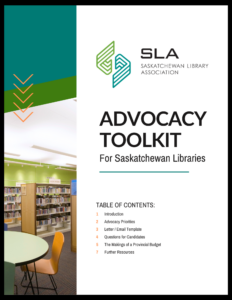
Advocacy on behalf of all Saskatchewan libraries is one of SLA’s core values. SLA’s Advocacy & Development Committee created this Advocacy Toolkit in 2024, modelled after the Manitoba Library Association’s Provincial Election Toolkit 2023, in the hope that these resources will enable libraries to better advocate for themselves.
The toolkit includes: a list of priorities for which to consider advocating, a letter template that can be customized for your elected official, questions to consider asking candidates during an election campaign, a timeline of how our provincial budget is created, and a list of further resources.
While many of the toolkit pieces are geared toward advocacy during an election, they can be customized for use at any time. Materials can be customized and distributed as needed.
View the Full Advocacy Toolkit
Social Media Campaign Resources
SLA’s Advocacy & Development Committee has developed a “Vote Libraries” social media campaign to support advocacy activities during election time: Any person or organization interested in promoting the “Vote Libraries” campaign or Advocacy Toolkit is encouraged to download, print, and/or distribute the below resources.
social media CAMPAIGN images
- 2024 Vote Libraries Facebook Post (PNG)
- 2024 Vote Libraries Instagram Post (PNG)
- 2024 Vote Libraries Twitter Post (PNG)
Position Statements
In the event of a major incident that may impact libraries and the greater information provider community, the SLA Board of Directors will investigate, and if appropriate, coordinate drafting a position statement.
Below are position statements SLA has made:
- SLA Statement on Material and Program Challenges (2024)
- SLA’s Commitment to Intellectual Freedom (2023)
- SLA’s Commitment to Open Access to Information, Resources, Programs, and Services (2023)
- SLA Voices Concern About Funding Cuts to Libraries (2017)
- SLA Supports CLA Statement on Cuts to Statistics Canada (2014)
- SLA Letter to the Honourable James Moore on Replacing the Librarian and Archivist of Canada (2013)
- Joint Statement on Qualities of a Successful Librarian and Archivist of Canada (2013)
Click here for SLA’s Guidelines for Drafting Position Statements.
SLA Advocacy Initiatives
SLA has carried out a number of advocacy initiatives in recent years.
2020: Elections and COVID-19
During the 2020 provincial and municipal elections, SLA created two documents to advocate for libraries and profile them as an invaluable part of Saskatchewan’s communities. One was a handout describing the role of libraries in our communities, which could be given to candidates in the elections. The second document was a letter sent to party leaders in the provincial election. SLA received a response from the Saskatchewan Party.
After the early months of the COVID-19 pandemic caused most businesses and public institutions to temporarily close, the Government of Saskatchewan released the Re-Open Saskatchewan Plan in April 2020. Public libraries were not included in the plan. SLA followed up with the Provincial Library and Literacy Office (PLLO) and learned that the Ministry of Education was looking into the matter.
SLA President Amy Rankin wrote a letter to the provincial government, asking that libraries be included in the plan. It requested that public libraries be included in one of the reopening phases and that PLLO assume an active role of support in discussing guidelines, protocols, and other considerations that may be helpful to public libraries in preparing for reopening.
2017: Libraries Face Severe Budget Cuts
In 2017, the Government of Saskatchewan proposed a budget cut to libraries, creating concern across the province about the impacts to Saskatchewan libraries, the library community, and residents. SLA engaged in several advocacy efforts to support Saskatchewan libraries. We found that the greatest defense is in numbers – every individual engaging in significant acts to apply pressure to the government.
SLA also participated in the Drop Everything and Read (DEAR) event, held on April 7, 2017. Nearly 6,000 people in 85 communities across Saskatchewan took part, calling on the government to reinstate funding to libraries and expressing the importance of libraries in their communities. (See photos of the event here, courtesy of CUPE Saskatchewan.)
The provincial government reversed its decision to cut library funding, largely because of the public outcry and the work of advocates across the province.
That fall, SLA’s President and Executive Director were interviewed for an advocacy television show about the value of public libraries in Saskatchewan. In 2018, SLA President Michael Shires published an article titled The Saskatchewan Spring of 2017: 34 Days That Shook the Provincial Government and Led to the Provincial Government Reinstating Funding to Public Libraries.
Below are documents with numerous links to the resources used by advocates and the media coverage the issue generated:
Canadian Federation of Library Associations
The Canadian Federation of Library Associations (CFLA-FCAB) is the united, national voice of Canada’s library community. As the national voice of Canada’s library communities, CFLA-FCAB will work to:
- advance library excellence in Canada
- champion library values and the value of libraries
- influence national and international public policy impacting libraries and their communities
The Saskatchewan Library Association is a member of CFLA-FCAB. Because of this, SLA members have access to CFLA-FCAB services, information and benefits through SLA.
Much of the work of CFLA is facilitated by strategic committees that have representation from member associations. Currently there are four strategic committees: Cataloguing and Metadata Standards Committee, Copyright Committee, Indigenous Matters Committee, and Intellectual Freedom Committee.
Brad Doerksen is CFLA-FCAB’s Prairie Provinces Representative (Saskatchewan and Manitoba). He brings the interests of Saskatchewan’s library community to the national table. Brad works as the Student Success Librarian at the University of Regina, and is a past member of the SLA Board and the Saskatchewan Multitype Library Board. To contact Brad, email him at brad.doerksen@uregina.ca.
Resources & Toolkits
- In 2019, The Partnership completed a jurisdictional scan of advocacy and communication strategies and best practices in its 12 library associations. The following document reflects information provided by each jurisdiction: Partnership Associations: Communication Strategies, Best Practices and Initiatives.
- This PowerPoint presentation was introduced at the Saskatchewan Libraries Conference 2017: Library Advocacy – You Can Do It! (PowerPoint Presentation)
- Maha Kumaran wrote a paper titled Libraries Matter, based on her research with Lorraine Salt
Archived SLA Letters to Stakeholders
- Premier Brad Wall’s reply (May 1, 2017)
- Letter to Premier Brad Wall (Apr. 25, 2017)
- Letter to Premier Brad Wall (Apr. 4, 2017)
- Federation of Sovereign Indigenous Nations (Apr. 18, 2017)
- Saskatchewan Association of Rural Municipalities (Apr. 4, 2017)
- Saskatchewan School Boards Association (Apr. 18, 2017)
- Saskatchewan Urban Municipalities Association (Apr. 4, 2017)
Advocacy Article Series
Promoting the Value of Libraries: Building a Plan
SLA has produced a series of background papers on advocacy that will be of use for years to come.